

The role of custom rods in angling: performance guide
TL;DR:
- Custom fishing rods are built to your specific needs, offering improved sensitivity, balance, and guide placement compared to factory models. Proper spine alignment and static load guide placement ensure better load distribution, resulting in more accurate casting and increased performance. Investing in a custom rod enhances not only your technique but also the overall fishing experience through tailored ergonomics and increased confidence.
Most anglers assume all fishing rods perform similarly — pick one off the shelf, attach your reel, and you’re ready. That assumption costs fish. The role of custom rods in angling is far more significant than most recreational fishers realize, shaping everything from how well you detect a bite to how accurately your lure lands fifty meters out. Custom fishing rods aren’t just premium gear for serious tournament competitors. They’re purpose-built tools designed around your body, your technique, and the fish you’re actually targeting. Here’s what changes when your rod is built for you.
Table of Contents
- What makes custom fishing rods different from factory models
- The science behind custom rods: spine alignment and static load guide placement
- Inside the custom rod building process: time, cost, and craftsmanship
- How custom rods enhance your angling experience and performance
- Custom rods vs high-end factory rods: a side-by-side comparison
- Why custom rods are more than tools — they are an extension of the angler
- Explore premium custom rod options and fishing gear at Just Fishing
- Frequently asked questions
Key Takeaways
| Point | Details |
|---|---|
| Precision design matters | Custom rods are built to your unique specifications for enhanced fishing performance. |
| Technical spine alignment | Aligning guides with the rod blank spine reduces twisting and improves casting accuracy. |
| Labor intensive build | Building a custom rod requires significant time and craftsmanship investment to achieve quality. |
| Performance benefits | Heightened sensitivity and balance from custom rods boost fishing success and enjoyment. |
| Cost vs use case | Custom rods pay off primarily for serious, technical anglers rather than casual users. |
What makes custom fishing rods different from factory models
Factory rods are designed for the broadest possible audience. That means compromises — in blank length, action, guide spacing, grip material, and balance. A custom rod eliminates those compromises by building every component around your specific needs.
The most immediate difference is construction intent. Custom rods are crafted to exact specifications: action (how far down the blank flexes), power (the rod’s overall stiffness), length, handle design, and guide type. Every choice serves your fishing style rather than a manufacturer’s production budget. The advantages of custom rods show up fast when you hold one that’s properly balanced for your reel.
One-piece blanks generally deliver the highest sensitivity because there’s no ferrule joint (the connection point in a two-piece rod) to interrupt the vibration traveling from the tip to your hand. But custom rods provide heightened sensitivity, improved casting accuracy, better balance matching rod and reel weight, and superior overall performance compared to off-the-rack rods. Two-piece designs remain a practical option for travel anglers without sacrificing much when built correctly.
Here’s what separates a custom build from factory production at the component level:
- Blank selection: Chosen for the specific species, technique, and environment, not the widest market segment
- Guide placement: Based on static load testing rather than a generic progressive spacing chart
- Grip material and length: Matched to your hand size and preferred fishing posture
- Balance point: Calibrated with your actual reel so the rod sits neutrally in your hand
- Thread wraps and epoxy: Applied by hand for both structural integrity and personal aesthetics
Pro Tip: Before ordering a custom rod, fish with your current reel attached to several blank styles in a shop or at a guide’s operation. The blank that feels neutral, not tip-heavy or butt-heavy, is your starting point for a balanced custom build.
Factory rods also use a progressive spacing chart for guide placement, a standard mathematical formula applied across the entire product line. Custom rods use static load testing, which we’ll examine closely in the next section, to identify where the blank actually flexes under real fishing loads.
The science behind custom rods: spine alignment and static load guide placement
Every carbon fiber rod blank has a spine. Think of it as a slight structural seam running the length of the blank where the carbon layers overlap during manufacturing. That seam creates an asymmetry in how the blank bends. It’s invisible to the eye but significant under load.
Finding the spine before building is non-negotiable in quality custom work. Off-spine guide placement causes twisting under load, reducing efficiency and stability, with strong spine suited for power builds and weak spine for finesse applications. If your guides are mounted on the wrong side of that spine, the rod rotates in your hand during a cast or a fight, bleeding away casting energy and forcing your wrist to compensate.
Here’s the step-by-step process for using spine alignment and static load testing correctly:
- Support the blank at both ends and apply gentle downward pressure at the midpoint. The blank will rotate naturally to its spine position.
- Mark the spine with a felt-tip marker at several points along the length. This line guides the entire build.
- Clamp the butt end of the blank and hang a known weight at the tip to simulate fishing load. The blank flexes into its natural curve.
- Mark the flex points along the blank under that load. These are your actual guide locations, not the chart’s theoretical positions.
- Repeat the static load test with guide prototypes taped in position to verify the flex pattern doesn’t shift.
- Build from the spine out, mounting every guide on the aligned plane.
“Static load testing for guide placement outperforms charts by matching the blank’s natural load curve, preventing uneven stress and improving casting.” How to build a custom fishing rod that actually performs
The practical result of this process is measurable. Technical rod building advances that use static load testing report improved casting distance, more consistent line control through the guides, and reduced stress fractures over time because the blank bends where it wants to, not where a chart assumes it will.
Pro Tip: On lighter finesse rods, mount guides on the weak side of the spine. On heavy power rods targeting offshore species, mount on the strong side. The difference in tracking accuracy is noticeable within the first fishing session.
Inside the custom rod building process: time, cost, and craftsmanship
Understanding the investment behind a quality custom rod changes how you value one. This is not a process measured in minutes.
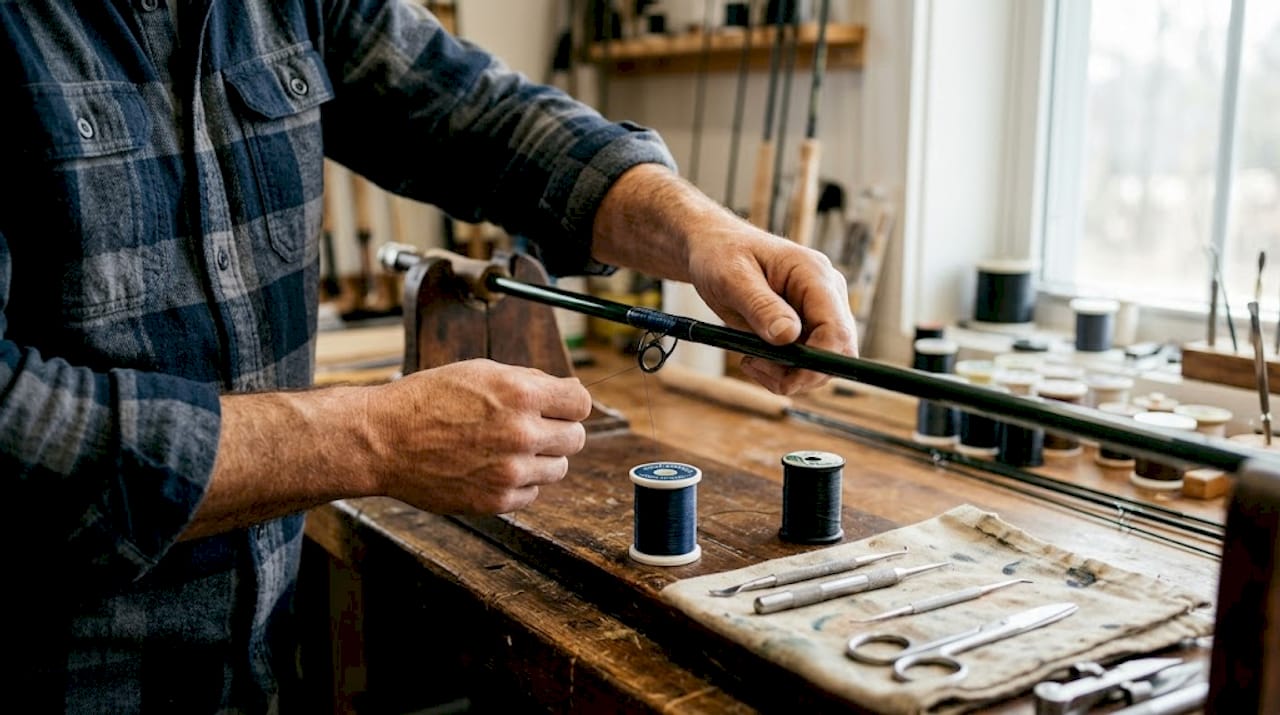
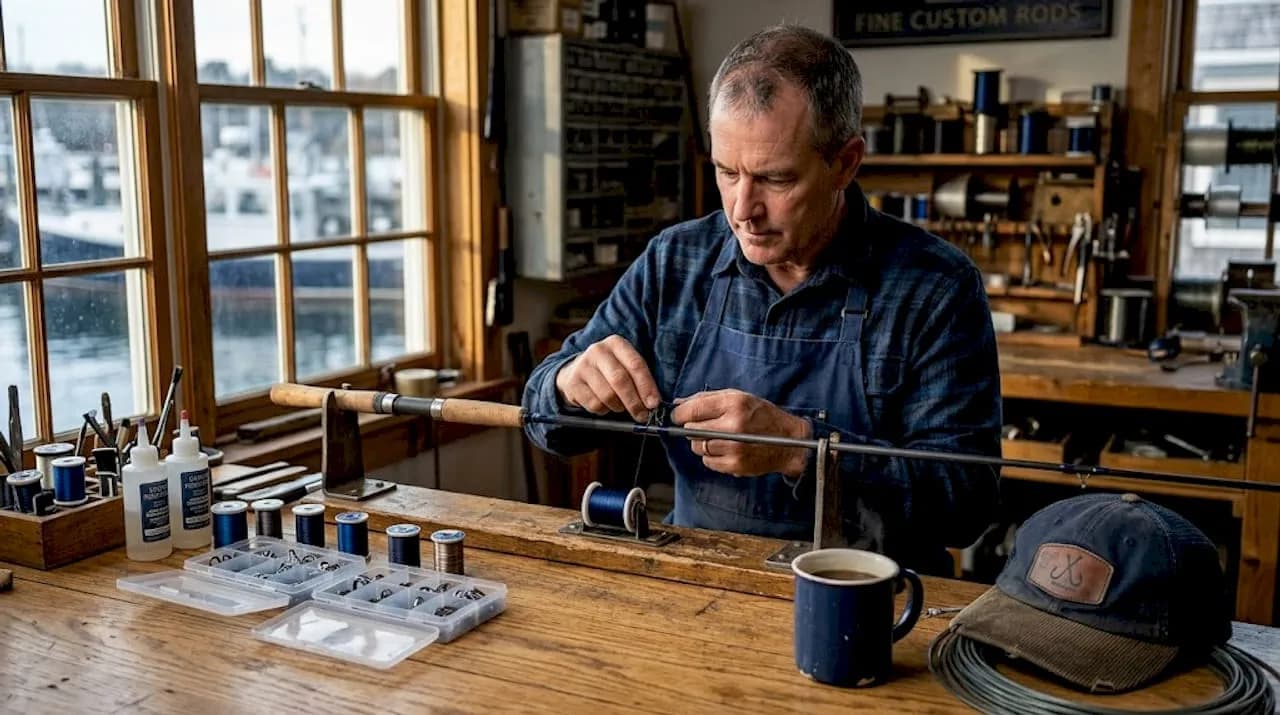
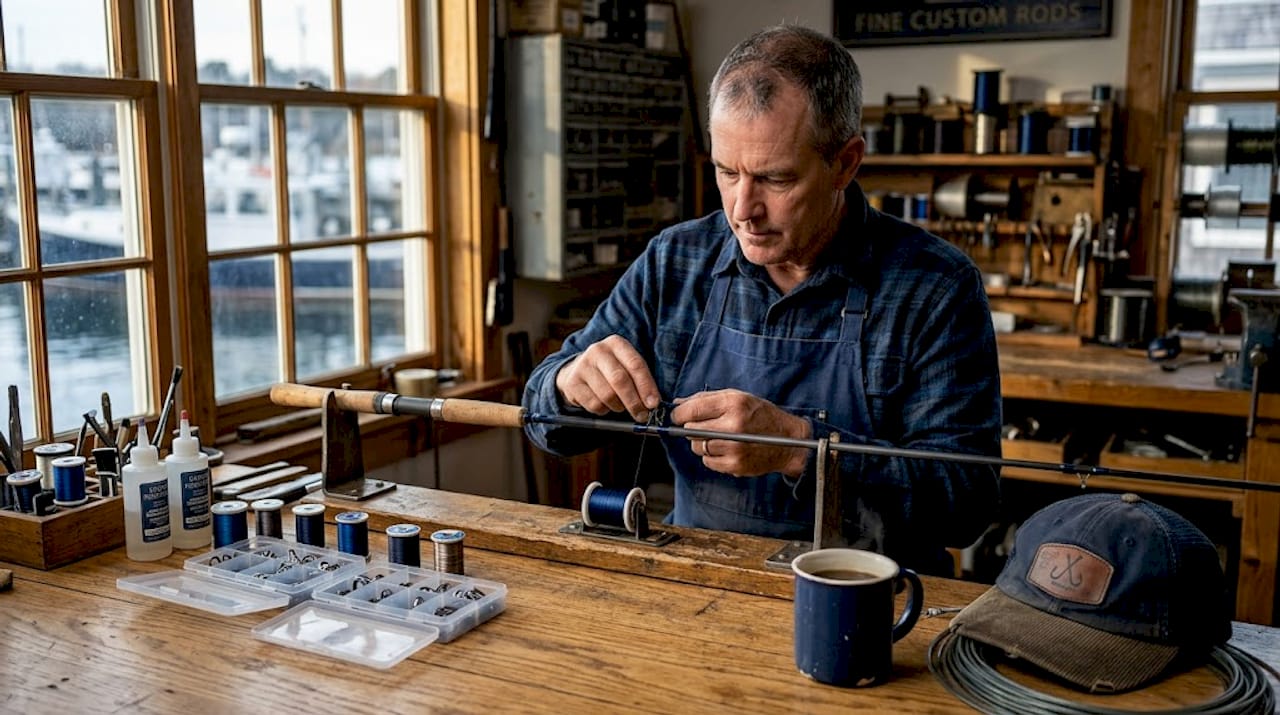
The building process takes 8 to 15 hours spread over 3 to 4 days, including spine marking, static load guide placement, and epoxy curing between each stage. Epoxy cannot be rushed. Apply it too early in the next coat and you trap air bubbles that weaken the finish and can crack the guide feet over time.
Custom fishing rod kits range from $50 to several hundred dollars depending on blank quality, guides, and custom artwork, with professional builds averaging 2 to 10 hours of valued labor. Here’s how that breaks down in practical terms:
| Component | Budget build | Mid-range | Performance build |
|---|---|---|---|
| Blank | $30 to $60 | $80 to $200 | $200 to $600+ |
| Guides (full set) | $15 to $40 | $50 to $120 | $120 to $300+ |
| Handle and reel seat | $10 to $30 | $30 to $80 | $80 to $200 |
| Thread and epoxy | $10 to $20 | $20 to $40 | $40 to $80 |
| Professional labor | $50 to $100 | $100 to $250 | $250 to $500+ |
A few key points about what those dollars actually represent:
- Blank quality drives performance more than any other component. A cheap blank with expensive guides will still underperform.
- Guide material matters in saltwater. Titanium frames with SiC (silicon carbide) inserts resist corrosion and reduce friction for braid users.
- DIY builds save money but rarely match professional finish quality on the first or second attempt. Guide wraps take practice to tension correctly.
- Custom artwork and personalized handle carving add cost but create a rod that is genuinely yours. Some anglers commission carved EVA foam handles or laser-etched reel seats.
Explore custom rod options that balance material quality with craftmanship if you’re not ready to build from scratch but want to step up from standard factory production.
How custom rods enhance your angling experience and performance
The technical groundwork translates directly to what happens on the water. Let’s connect the build decisions to real fishing outcomes.
Sensitivity is the most immediately felt benefit. High-modulus carbon blanks (a measure of stiffness-to-weight ratio in the fiber) transmit vibration more efficiently than standard graphite. Heightened sensitivity and proper spine alignment improve detecting light bites and reduce casting fatigue, particularly relevant when bottom fishing at depth or fishing in current where reading the lure’s contact with structure is critical.
Balance matters more during a six-hour session than during a five-minute shop test. A rod perfectly balanced to your reel reduces the micro-fatigue that accumulates in your wrist and forearm. Custom rods offer accuracy in casting, heightened sensitivity, matched rod and reel balance, and simple enjoyment. That enjoyment isn’t superficial. When a tool feels right, you fish with more confidence and patience.
The improving angling with custom rods conversation also includes technique-specific benefits:
- Finesse applications: Light action custom rods with sensitive tips help you work soft plastics and detect subtle taps before the fish fully commits
- Jigging: Balanced, fast-action rods with precise guide placement improve vertical jigging rhythm and lure control at depth
- Topwater: Medium-fast custom builds with comfortable grips let you work surface lures for hours without hand cramp
- Heavy offshore: High-power custom rods calibrated to specific drag settings reduce angler exhaustion during long fights
Pro Tip: When specifying a custom rod for jigging, request the builder to match the rod’s weight rating to your most-used jig weight, not the maximum the blank can handle. Fishing a 150g jig on a rod rated to 300g makes the presentation feel dead.
Custom rods vs high-end factory rods: a side-by-side comparison
High-end factory rods have improved significantly. Some now include spine alignment and finer guide materials. So when does a custom rod actually justify the additional cost and wait time?
| Feature | Custom rod | Premium factory rod |
|---|---|---|
| Spine alignment | Always performed | Rarely, inconsistently |
| Guide placement | Static load tested | Progressive chart formula |
| Fit to angler | Exact specifications | Closest available model |
| Lead time | 2 to 8 weeks | Immediate |
| Cost | Higher, variable | Set retail price |
| Repairability | Builder can replicate | Brand parts required |
| Uniqueness | Fully personalized | Standardized |
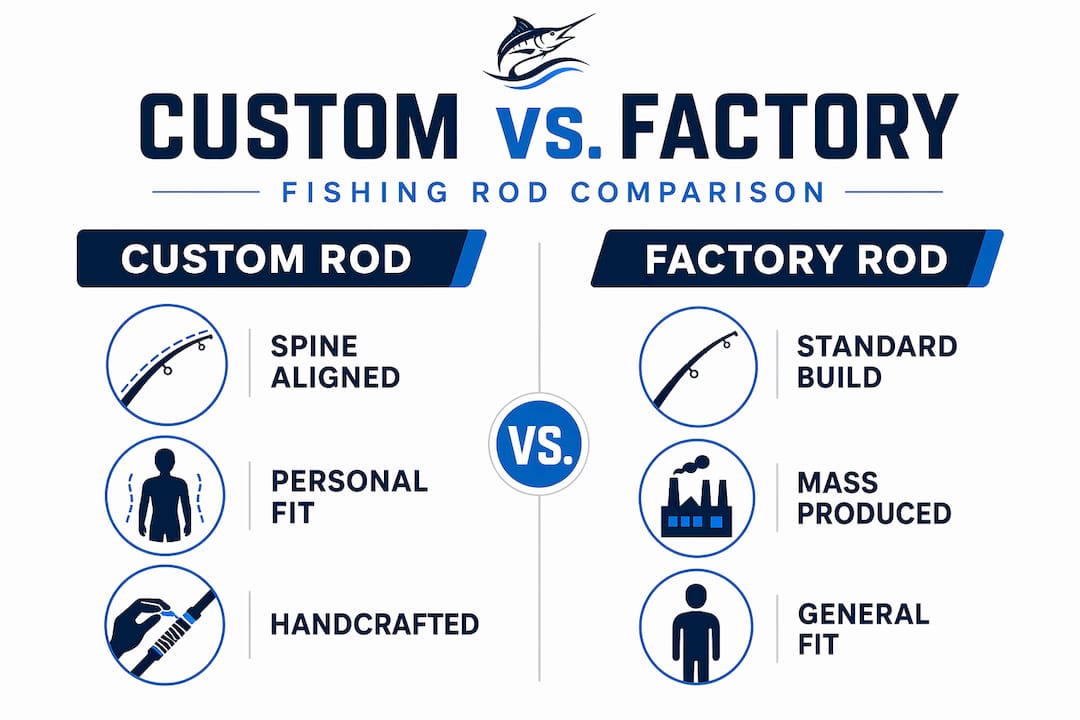
Custom rods gain value in technical finesse, heavy offshore, ergonomic needs, and ultra-sensitive bottom reading that factory rods often cannot match.
The honest answer is that factory rods, including quality options like those in the Shimano Trevala series, are excellent tools for anglers who fish a variety of conditions without deep specialization. Where factory rods fall short is at the edges: extremely light finesse fishing, heavy stand-up offshore work, or situations where an angler’s physical dimensions (very large or small hands, height, reach) make standard sizing genuinely uncomfortable.
Key takeaways for your decision:
- Choose custom if you fish one technique repeatedly and want every advantage available
- Choose factory if you fish varied styles and need multiple rods without significant budget
- Consider both as part of a well-rounded setup, with a custom rod for your primary method and factory rods for less frequent applications
Why custom rods are more than tools — they are an extension of the angler
Here’s a perspective that most gear reviews skip over entirely: the psychological dimension of a custom rod matters, and dismissing it as marketing sentiment misses something real.
When a rod is crafted to exact specifications with extra care, it becomes an extension of the angler. That’s not a metaphor. It’s a description of what happens when balance, sensitivity, and ergonomics align with your body and technique. The rod stops being something you operate and becomes something you express yourself through.
We’ve seen this repeatedly with anglers who fish demanding destinations: the Maldives GT (giant trevally) flats, the deep jigging grounds off Oman, the mixed species challenges in the Seychelles. Anglers who arrive with rods built for those specific conditions fish with a different quality of attention. They’re not fighting their gear. They’re fishing.
The custom rod uniqueness aspect goes beyond specs. Knowing the exact blank modulus, the reason for each guide’s position, and the grip’s cut to your hand size creates ownership that changes how you handle the rod during a fight. You trust it. That trust affects decision-making. You apply more pressure at the right moment because you know what the rod can take. You feel the bite sooner and react faster.
Custom rods also reward patience. The weeks between ordering and receiving a completed build create anticipation that rarely exists with next-day shipping. Anglers who have waited tend to fish more deliberately with the result. There’s something worth preserving in that.
Explore premium custom rod options and fishing gear at Just Fishing
Ready to take your setup from generic to genuinely yours? Just Fishing offers an expertly curated selection of performance rods built for serious anglers targeting a wide range of species and environments.
Explore the Blackfin Carbon Elite Full Grip Rods, designed for anglers who demand sensitivity and power in a single build, or start with the Blackfin Solo Rods for a lighter, finesse-focused option that doesn’t sacrifice backbone. Pair your rod with the right terminal tackle, jigs, and lures by browsing the full range at shop premium fishing gear. Whether you’re preparing for a trip to the Maldives, the UAE, or beyond, Just Fishing’s gear selection is built to match the destinations and the fish.
Frequently asked questions
What is the main advantage of a custom fishing rod over a factory rod?
Custom fishing rods are tailored to your specifications with precise spine alignment and guide placement, delivering better sensitivity, casting accuracy, and balance than standard factory rods. Custom rods provide heightened sensitivity and superior overall performance compared to off-the-rack rods.
How long does it typically take to build a custom fishing rod?
Building a custom fishing rod generally takes 8 to 15 hours spread over 3 to 4 days, including critical epoxy curing times between each stage of construction.
Is building a custom rod cost-effective for beginner anglers?
For casual or beginner anglers, factory rods are often more economical. Custom builds justify cost mainly in technical, ergonomic, or specialized fishing scenarios where factory rods genuinely fall short.
Why is spine alignment important in custom rod building?
Spine alignment ensures guides are positioned along the blank’s strongest structural plane. Off-spine guide placement causes twisting under load, reducing casting efficiency and rod stability in ways that are felt throughout every fishing session.
Can a custom rod improve detection of light bites?
Yes. Custom rods built with high-modulus blanks and precise guide placement significantly enhance sensitivity for detecting light bites that would go unnoticed with standard factory rods, particularly in finesse and technical fishing applications.