


Fly fishing: techniques, gear, and essentials explained
TL;DR:
- Fly fishing uses a weighted line to cast nearly weightless flies, changing its technique and gear.
- Mastering presentation, water reading, and nymphing techniques is more important than fly selection.
- Beginners can start with a $150-$300 setup and focus on local water to build skills efficiently.
Fly fishing looks like fishing. You’re near water, you have a rod, and you’re trying to catch fish. But the moment you watch someone make a fly cast, you realize something fundamentally different is happening. Fly fishing uses a weighted fly line to carry a nearly weightless artificial fly to the fish, while conventional fishing relies on the lure’s own weight to pull the line out. That single difference changes everything: the gear, the technique, the mindset, and honestly, the entire experience. Whether you’re curious or ready to make your first cast, this guide breaks it all down clearly.
Table of Contents
- What makes fly fishing unique?
- Essential gear for fly fishing: What you’ll need and why
- Fly casting mechanics: How it works and key techniques
- Fly fishing techniques: Dry flies, nymphs, and streamers
- Best practices and pro tips for successful fly fishing
- Why most anglers get fly fishing wrong: Lessons from the water
- Get started on your fly fishing journey
- Frequently asked questions
Key Takeaways
| Point | Details |
|---|---|
| Fly fishing is unique | This style uses a weighted line to delicately cast lightweight flies, unlike conventional lure fishing. |
| Essential beginner gear | A 9ft 5wt rod and floating line offer the most versatility for new fly anglers. |
| Casting technique matters | Mastering the smooth acceleration and abrupt stop of fly casting unlocks accurate, natural presentations. |
| Nymphing is most effective | Since trout feed mainly underwater, nymphing often outperforms dry fly fishing for catch rates. |
| Practice and presentation | Focusing on presentation and practice—rather than perfect fly choice—leads to better success on the water. |
What makes fly fishing unique?
With the basics in mind, let’s dig deeper into exactly what makes fly fishing different from what you might expect.
In conventional spin fishing, you tie on a heavy lure, point the rod, and the lure’s weight pulls the line off the spool. Simple. Fly fishing flips this completely. The fly line itself is weighted, and the fly, which might weigh almost nothing, just rides along at the end. This means you’re casting the line, not the fly. It’s a subtle but massive shift in how you think about every movement.
Fly fishing also demands that you think like the fish. Flies are tied to imitate insects, crustaceans, or small baitfish, and your job is to present them so naturally that a fish can’t tell the difference. More than 40 species in the US can be targeted with fly fishing, from trout in mountain streams to redfish on saltwater flats.
The American Fly Fishing Trade Association (AFFTA) standardized a weight scale from 1 to 14 for fly lines and rods. Lighter weights (1 to 4) target small fish in delicate conditions. Heavier weights (8 to 14) are built for saltwater giants. Most fly lines run between 80 and 110 feet in total length.
| Feature | Fly fishing | Conventional fishing |
|---|---|---|
| What carries the line | Weighted fly line | Lure or sinker weight |
| Fly/lure weight | Nearly weightless | Heavy |
| Casting motion | Overhead loops, back-and-forth | Single forward cast |
| Primary targets | Trout, bass, salmon, bonefish | Almost all species |
| Skill curve | Steeper | Gentler |
| Visual engagement | High (sight fishing, dry fly) | Moderate |
“Fly fishing is as much about reading the water and understanding fish behavior as it is about casting. The presentation is everything.”
Fly fishing also rewards patience and observation. Sight fishing, where you spot the fish before casting, is one of its most thrilling elements. Tight line management, meaning keeping unnecessary slack out of your line, is critical for detecting strikes and controlling your fly’s drift. These tactical layers are what keep anglers hooked for life.
Essential gear for fly fishing: What you’ll need and why
Now that you’ve seen how fly fishing’s approach stands apart, it’s time to look at the essential equipment that brings it to life.
The gear list for fly fishing is specific, and each piece has a real job to do. Core gear includes a fly rod, reel, weighted fly line, tapered leader, tippet, and artificial flies. For beginners, a 9-foot 5-weight (5wt) rod is the gold standard. It’s versatile enough to handle most freshwater situations, from small streams to bigger rivers.
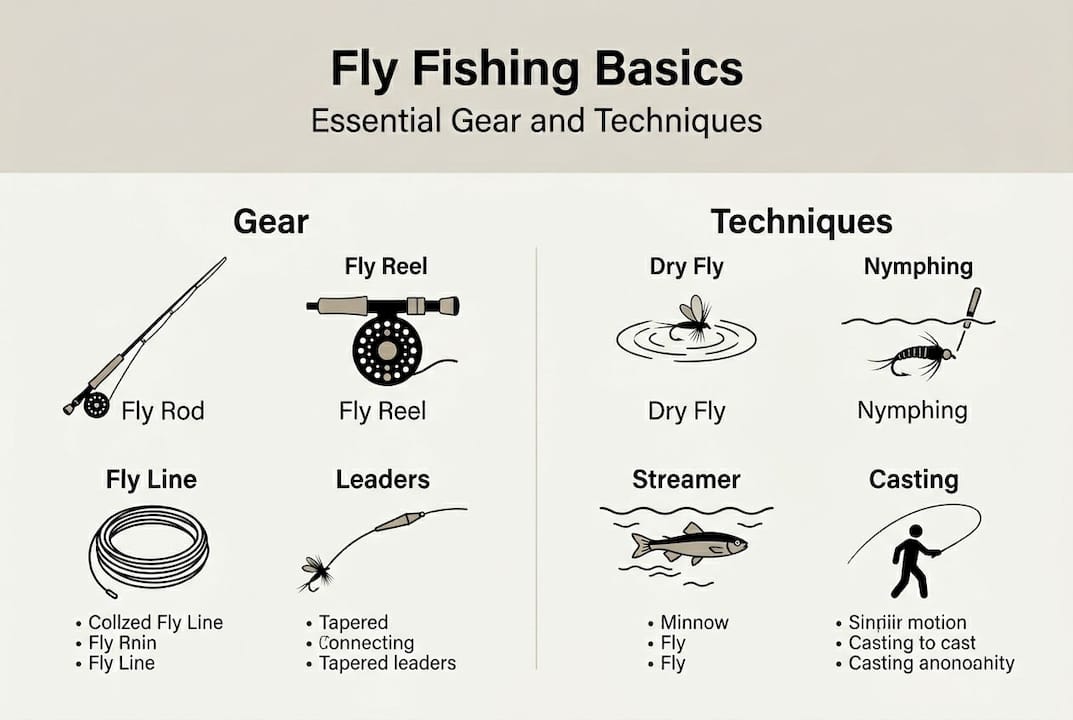
| Gear | Purpose | Beginner tip |
|---|---|---|
| Fly rod | Casts the line, loads energy | Start with a 9ft 5wt |
| Fly reel | Holds line, provides drag | Match to rod weight |
| Fly line | Carries the fly to the target | Use a weight-forward floating line |
| Leader | Connects line to fly, tapers down | 7.5 to 12ft tapered leader |
| Tippet | Extends leader, near-invisible | Match to fly size |
| Flies | Imitates prey | Start with a small variety pack |
A solid beginner setup costs between $150 and $300, and a 9ft 5wt rod covers 90% of scenarios you’ll encounter on local waters. You don’t need to spend more than that to start learning and catching fish.
Must-have accessories beyond the core kit:
- Polarized sunglasses for spotting fish and protecting your eyes
- Forceps or hemostats for safely removing hooks
- Fly box to organize and protect your flies
- Waders and wading boots if you plan to wade in streams
- Landing net for safe catch-and-release
Browsing premium fly rods is a great way to see what quality looks like before you buy, and you can compare options across the full range of fly fishing gear online to find what fits your budget.
Pro Tip: Start with versatile, mid-range gear and resist the urge to buy specialty items right away. You’ll learn faster with simple, reliable equipment, and you’ll know exactly what to upgrade once you’ve spent real time on the water.
Fly casting mechanics: How it works and key techniques
With your gear ready, let’s walk through the fundamental mechanics that make a fly cast both graceful and effective.
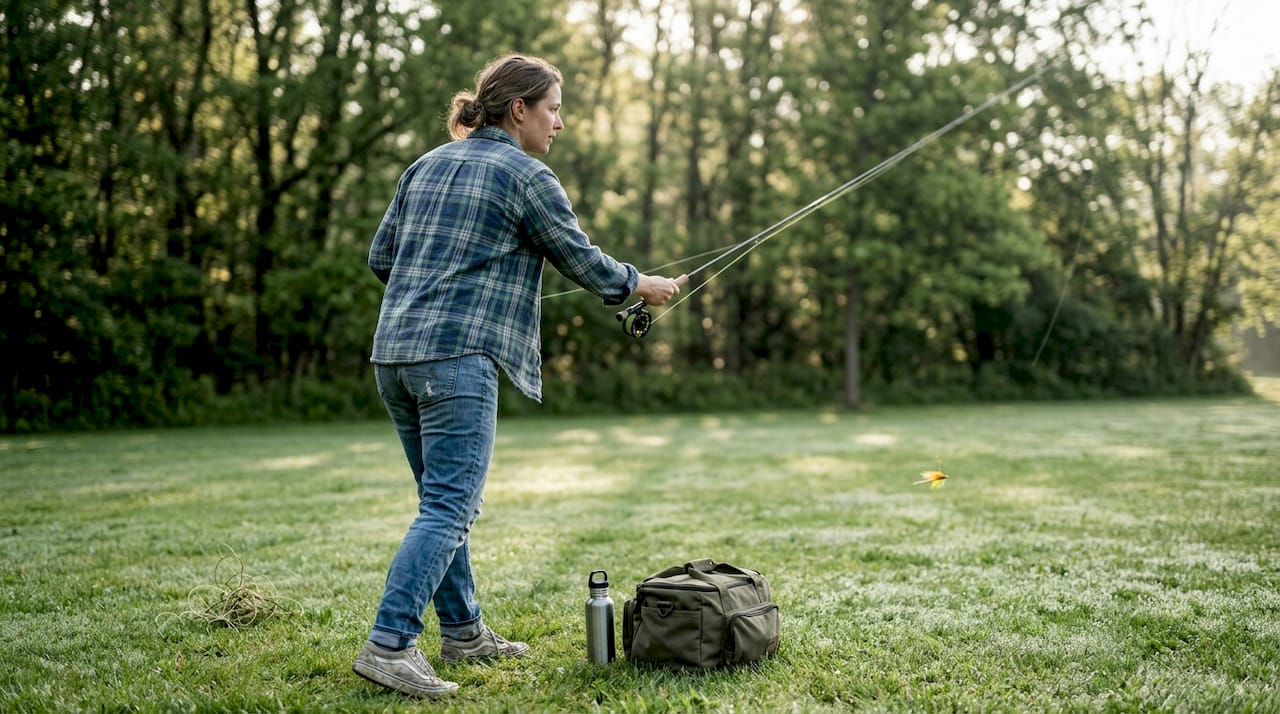
Fly casting looks elegant from a distance, but it’s built on a few clear physical principles. The rod loads energy through smooth acceleration to an abrupt stop, forming tight loops as the rod tip travels in a straight path. The tighter the loop, the more accurate and efficient your cast. Sloppy loops waste energy and drop the fly short or off-target.
Here’s how a basic overhead cast breaks down:
- Start with a straight line. Remove all slack from your fly line before you begin. A cast built on slack goes nowhere.
- Lift smoothly. Raise the rod tip slowly at first, then accelerate as the line comes off the water.
- Stop abruptly on the back cast. The rod stops at roughly the 1 o’clock position. Let the line unroll behind you fully before moving forward.
- Drive forward with acceleration. Move the rod forward with increasing speed, stopping sharply at the 10 o’clock position.
- Let the line unfurl. The line rolls forward, the leader straightens, and the fly lands gently on the water.
- Manage your slack. Once the fly lands, keep light control of the line with your non-casting hand.
This is completely different from spin casting, where you simply load and release. In fly casting, you’re actively managing energy through both the forward and back cast. The line is always working.
Pro Tip: Practice your cast with a dry fly on a lawn or calm water before targeting fish. Watching the fly land gives you instant feedback on your loop shape and timing, which speeds up learning dramatically.
For those looking at gear to match these mechanics, legacy fly rods offer a smooth action that helps beginners feel the rod load more easily. Pairing your rod with quality fluorocarbon fly line also improves your presentation in clear water situations.
Fly fishing techniques: Dry flies, nymphs, and streamers
Mastering the cast is just the start; the next challenge is choosing and working your flies for real results.
There are three main technique families in fly fishing, and knowing when to use each one is what separates a good angler from a great one.
Dry fly fishing is what most people picture when they think of fly fishing. The fly floats on the surface, imitating an adult insect. Fish rise to take it, and you watch the whole thing happen. It’s visual, exciting, and deeply satisfying. The catch? Dry flies account for only 10 to 20% of a trout’s diet, which means it’s not always the most productive approach.
Nymphing targets fish feeding below the surface, which is where they spend most of their time. Nymphs imitate larval insects drifting in the current. This method is quietly dominant because nymphs represent up to 90% of a trout’s diet in many river systems. If you want to catch more fish, learn to nymph.
Streamers are larger flies that imitate baitfish, leeches, or crayfish. You retrieve them actively through the water, triggering aggressive strikes. Streamers are excellent for targeting big, predatory fish.
Key factors that affect all three methods:
- Mending: Adjusting the fly line on the water after the cast to control the fly’s drift and avoid unnatural drag
- Dead-drift: Allowing the fly to move naturally with the current, with no added movement from the angler
- Presentation: Where the fly lands and how it behaves matters more than which pattern you chose
“The fly pattern gets you in the door, but presentation keeps you at the table.”
Matching the hatch, meaning selecting a fly that closely resembles what insects are active on the water that day, is a core skill. Watch the water surface, check the streamside vegetation, and observe what fish are rising to before tying on a fly.
Best practices and pro tips for successful fly fishing
Techniques alone aren’t enough; smart strategy and practical know-how are what turn outings into lifelong fishing memories.
Here’s a step-by-step approach to planning your first fly fishing trip:
- Choose accessible water. Start with a local river, stream, or stocked lake. You don’t need to travel far to learn.
- Research the fish and their food. Know what species live there and what they typically feed on by season.
- Arrive early. Fish are most active in the early morning and late evening. Beat the crowds and the heat.
- Read the water. Fish hold in specific spots: behind rocks, in current seams, at the tail end of pools. Look for structure.
- Approach quietly. Position yourself upstream or downstream of the fish, move slowly, and stay low. Fish spook easily.
- Match your fly to conditions. Check what insects are hatching and choose accordingly.
- Practice your cast before targeting fish. A few minutes of warm-up saves a lot of frustration.
- Land fish quickly and release carefully. Keep the fish in the water as much as possible and support its body.
Pro Tip: Use barbless hooks whenever possible. They make hook removal faster, reduce injury to the fish, and many catch-and-release waters require them. Pinching the barb on a standard hook takes five seconds and makes a real difference.
Common beginner mistakes to avoid: casting too hard (it creates wide, sloppy loops), wading too fast (it spooks fish and muddies the water), and changing flies too often before giving each one a real chance to work.
Why most anglers get fly fishing wrong: Lessons from the water
Bringing it all together, here’s a candid look at what actually separates successful fly anglers from the rest.
Most beginners obsess over fly selection. They spend hours studying pattern catalogs, debating whether a size 16 Adams is better than a size 18 Elk Hair Caddis. Here’s the uncomfortable truth: dry fly fishing is romanticized as the ‘aristocrat’ of angling, but presentation consistently trumps exact fly choice according to experienced guides and researchers alike.
A perfectly presented generic fly will outfish a perfectly matched fly with a dragging, unnatural drift every single time. Stealth, water reading, and drift control are the real skills. The fly is almost secondary.
We’ve also seen anglers skip nymphing entirely because it lacks the visual drama of a surface rise. That’s leaving fish on the table. Embracing nymphing early accelerates your development faster than any other single decision.
Build your skills locally. Short, frequent sessions on familiar water teach you more than one big annual trip to a famous river. You start to see patterns, understand the fish’s rhythms, and develop real confidence. Trial and error, not perfection, is the actual path forward.
Get started on your fly fishing journey
Ready to make your first cast? Here’s where to go next.
Fly fishing rewards those who take action. Reading about it is useful, but nothing replaces time on the water with the right gear in hand. At Just Fishing, we make it easy to take that next step, whether you’re browsing quality gear or looking for your first guided adventure.
Our curated selection of rods, reels, lines, and accessories is built for anglers at every level. If you’re ready to go beyond local waters, explore our range of fishing trips across destinations like the Maldives, Seychelles, Oman, and Kenya. Guided experiences are one of the fastest ways to accelerate your learning while enjoying world-class fishing.
Frequently asked questions
Is fly fishing suitable for beginners?
Yes, fly fishing is approachable for all skill levels with the right basic setup. A 9ft 5wt rod covers 90% of scenarios, and starting on local waters keeps the learning curve manageable.
What are the main types of flies in fly fishing?
The three main types are dry flies, nymphs, and streamers. Each targets a different portion of the water column and suits different feeding behaviors and conditions.
How much does a beginner’s fly fishing setup cost?
A quality beginner kit typically costs between $150 and $300. Beginner setups in this range include a rod, reel, line, leader, and a basic selection of flies.
What’s the difference between fly fishing and regular fishing?
Fly fishing uses a weighted line to cast a nearly weightless fly, while conventional fishing relies on the lure’s own weight to carry the line out. This changes the casting technique, gear, and overall approach entirely.
Why is nymphing often more effective than dry fly fishing?
Nymphs account for 70 to 90% of a trout’s diet, meaning fish feed below the surface far more often than at the top. Nymphing puts your fly where the fish are actually eating.