Fishing Tourism Trends in 2026: What Anglers Need to Know
June 08, 2026, 336
Fishing Tourism Trends in 2026: What Anglers Need to Know
TL;DR:
- Fishing tourism in 2026 is driven by increasing demand for exotic destinations, strict regulations, and a focus on sustainability. Travelers prioritize species-specific experiences, improved infrastructure, and destination transparency, making compliance and conservation key to trip success. Market growth, regulatory updates, and socio-economic data integration are transforming how and where anglers travel worldwide.
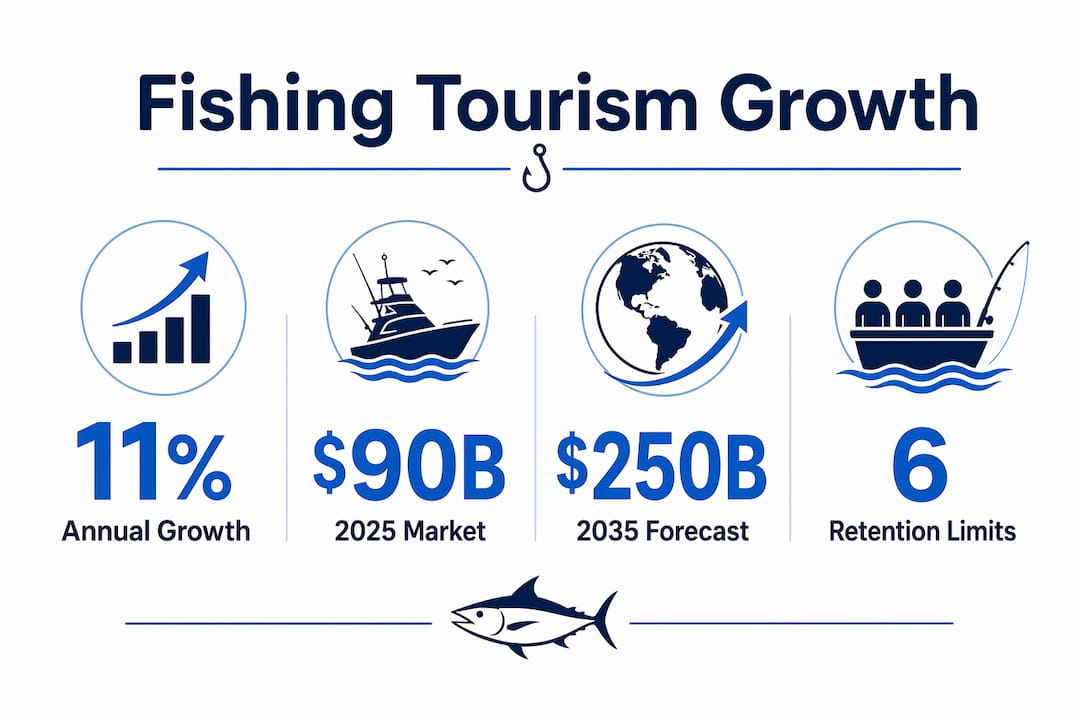
Fishing tourism in 2026 is defined by three forces reshaping every trip: explosive market growth driven by demand for exotic destinations, tighter species-specific regulations, and a formal shift toward sustainable, low-impact angling. The fishing tourism market was valued at $90 billion in 2025 and is forecast to reach $250 billion by 2035, growing at an 11% CAGR. That trajectory reflects a fundamental change in how anglers think about travel. The trends in fishing tourism 2026 are not incremental. They represent a structural shift in where people fish, what they can keep, and what they expect from the experience.
How are angler preferences shifting toward exotic fishing locations in 2026?
The single biggest driver of fishing tourism market growth is experience-seeking behavior. Anglers are no longer satisfied with familiar local waters. They want giant trevally in the Maldives, blue marlin off the coast of Morocco, and yellowfin tuna in the Seychelles. The 11% CAGR growth forecast through 2035 is a direct reflection of this demand for novel, remote, and scenically dramatic fishing environments.

Fishing entertainment media has accelerated this shift significantly. YouTube channels, fishing podcasts, and social media accounts dedicated to exotic species have created a global audience of anglers who now plan trips around specific fish and specific places. A viewer who watches a GT popper session in Socotra does not just admire it. They book a trip. This media-to-booking pipeline is one of the most underappreciated forces in the future of fishing tourism.
Infrastructure improvements are making previously inaccessible destinations viable. Improved air connectivity to East Africa, the Arabian Peninsula, and Pacific island groups has reduced the logistical friction that once made exotic fishing trips the exclusive domain of wealthy or highly motivated travelers. Destinations like Oman, Kenya, and Iceland are now within realistic reach for a broader range of anglers.
- Demand is concentrating around species-specific experiences: GT on poppers, sailfish on live bait, and permit on fly
- Remote destinations with limited fishing pressure are commanding premium prices
- Group and guided charter bookings are growing faster than independent travel in this segment
- Social media content from destinations directly influences booking decisions within weeks of posting
Pro Tip: When researching top fishing destinations 2026, search for destinations by target species first, then filter by season and access. This approach produces far more useful results than searching by country alone.
What regulatory changes in 2026 are shaping fishing tourism experiences?
Regulation is now a trip-planning variable, not an afterthought. The most significant 2026 update affecting U.S.-based fishing tourism is the new recreational Atlantic bluefin tuna retention framework, which runs from June through December 2026. Vessel type determines retention limits: private vessels may keep two fish, charter boats three, and headboats six, with size restrictions applied to each category.
The Gulf of America is excluded from these retention allowances entirely, which has direct consequences for trip routing and destination marketing in that region. Operators who target bluefin tuna must now design itineraries around vessel classification and geographic boundaries, not just seasonal fish movement. Ignoring these rules creates legal exposure and ruins the experience for paying clients.
| Vessel type | Retention limit | Key restriction |
|---|---|---|
| Private vessel | 2 fish | Size limits apply |
| Charter boat | 3 fish | Size limits apply |
| Headboat | 6 fish | Size limits apply |
| Gulf of America | 0 fish | Full exclusion zone |
Licensing, permit compliance, and mandatory reporting are also tightening across multiple jurisdictions. Operators who map vessel types and targeted fish classes into their itinerary design early reduce conflicts and deliver cleaner, more compliant trips. This is not just a legal requirement. It is a competitive differentiator for charter services that want repeat clients.
Pro Tip: Before booking any offshore charter in 2026, ask the operator directly which vessel classification they hold and whether the target species has active retention limits in that region. A reputable operator will answer immediately and in detail.
How is sustainability influencing fishing tourism messaging in 2026?
Sustainable fishing tourism is no longer a niche talking point. It is the dominant messaging framework at the industry’s most visible trade events. DAFV, the German Fishing Association and a member of the European Anglers Alliance, formally promoted angling as a contemporary, sustainable activity at the 2026 REISEN & CARAVANING Hamburg trade fair. This signals that sustainability has moved from grassroots advocacy into mainstream industry positioning.
The concept driving this shift is fishing tourism as a “high value, low impact” leisure activity. The argument is straightforward: anglers spend significant money in local economies while removing far fewer fish than commercial operations. European angling groups have built their 2026 tourism messaging around this framing, and it is resonating with a traveler segment that wants adventure without ecological guilt.
Eco-conscious anglers now expect destinations to demonstrate compliance, not just claim it. Catch-and-release practices, gear restrictions, and habitat protection programs are becoming standard expectations rather than optional extras. Destinations that cannot show proof of sustainable management are losing bookings to those that can.
- Catch-and-release rates are rising across saltwater destinations as a direct response to traveler expectations
- Gear restrictions, including barbless hooks and non-toxic weights, are being adopted voluntarily by leading operators
- Conservation partnerships between fishing lodges and marine research organizations are becoming a marketing asset
- Travelers are actively researching destination sustainability records before committing to bookings
The practical implication for trip planning is clear. When evaluating top destinations for fishing in 2026, look for operators with documented conservation programs, transparent reporting, and affiliations with recognized bodies like the European Anglers Alliance or local fisheries management authorities.
Why is socio-economic data becoming essential in managing fishing tourism?
The World Recreational Fisheries Conference in February 2026 produced a clear directive: fisheries management must move beyond catch-only data and incorporate angler spending and travel patterns into decision-making. This shift has direct consequences for how destinations set access rules, allocate guide licenses, and design seasonal restrictions.
The scale of the issue is larger than most people realize. Recreational fishing harvest in U.S. inland waters is estimated to be 17 to 48 times greater than United Nations reported figures. That gap means regulators have been making decisions based on a fraction of the actual data, and the correction is now underway. Rising regulatory scrutiny and data-driven management approaches are the direct result.
“Socio-economic impact measurements enable destinations to justify resource access and adapt guide allocations, influencing angler trip patterns and expectations.” — World Recreational Fisheries Conference Report, 2026
Here is what this means practically for anglers planning trips in 2026:
- Destinations that can demonstrate strong local economic contributions from fishing tourism are more likely to maintain open access and favorable seasons.
- Regions where angler spending data is weak or absent face higher risk of restrictive management decisions based on precautionary principles.
- Booking with local guides and staying in locally owned accommodation directly strengthens the economic case for continued angler access.
- Anglers who participate in voluntary data collection programs, such as catch reporting apps, contribute to the evidence base that protects future access.
The integration of socio-economic data into fisheries management is not just a policy development. It is a feedback loop that rewards destinations and anglers who engage transparently with the system.
What are the top fishing destinations and opportunities emerging in 2026?
The top fishing destinations in 2026 share three characteristics: access to exotic or high-demand target species, improving infrastructure, and a credible sustainability story. Norway, Costa Rica, Iceland, and Thailand each represent a different version of this formula, and each is attracting a distinct type of angler.
Norway draws anglers targeting giant halibut and Atlantic cod in fjord systems that are genuinely difficult to access without local knowledge. Iceland offers wild Atlantic salmon rivers with strictly managed catch limits that actually protect the resource. Costa Rica remains one of the premier billfish destinations in the world, with sailfish and marlin available year-round off both coasts. Thailand is emerging as a freshwater exotic destination, with arapaima, giant snakehead, and Mekong giant catfish drawing anglers who want species they cannot find anywhere else.
| Destination | Target species | Key draw | Sustainability status |
|---|---|---|---|
| Norway | Halibut, Atlantic cod | Fjord access, remote fishing | Strong management framework |
| Iceland | Atlantic salmon | Wild rivers, strict limits | Highly regulated |
| Costa Rica | Sailfish, marlin | Year-round billfish action | Catch-and-release culture |
| Thailand | Arapaima, giant snakehead | Exotic freshwater species | Managed fisheries growing |
| Maldives | Giant trevally, yellowfin tuna | Indian Ocean access | Marine protected areas |
For anglers using platforms like Justfishinggroup, the Maldives, Seychelles, Oman, and Kenya represent the strongest combination of exotic species access and organized trip infrastructure in the Indian Ocean and East Africa region. These destinations align directly with the fishing travel trends driving market growth in 2026.
Key takeaways
Fishing tourism in 2026 is shaped by market growth, regulatory precision, sustainability expectations, and socio-economic data integration working together to redefine where and how anglers travel.
| Point | Details |
|---|---|
| Market growth is accelerating | The sector is forecast to grow at 11% CAGR, reaching $250 billion by 2035. |
| Regulations require early planning | U.S. Atlantic bluefin tuna limits vary by vessel type and exclude the Gulf of America entirely. |
| Sustainability is now a baseline expectation | Anglers expect documented conservation practices, not just verbal commitments from operators. |
| Socio-economic data protects access | Destinations that demonstrate angler spending contributions are better positioned to maintain open seasons. |
| Exotic destinations are leading growth | Norway, Iceland, Costa Rica, Thailand, and Indian Ocean destinations are drawing the most demand. |
Why I think most anglers are planning 2026 trips the wrong way
Most anglers I talk to still plan trips around species availability and cost. Those are reasonable filters, but they miss the two factors that will actually determine trip quality in 2026: regulatory compliance and destination sustainability credentials.
The Atlantic bluefin tuna retention rules are a perfect example. An angler who books a headboat trip expecting to keep six fish, then discovers the vessel is classified differently or the location falls within an exclusion zone, has wasted a significant investment. Regulatory homework done before booking is not bureaucratic tedium. It is the difference between a successful trip and a frustrating one.
On sustainability, I have seen destinations lose access rights within a single season because they could not demonstrate responsible management to regulators. The anglers who booked those trips lost their deposits and their windows. The destinations that survived were the ones with documented programs and transparent data. That is not a coincidence.
My advice for 2026 is to treat sustainability credentials and regulatory compliance as primary selection criteria, not secondary ones. The fishing travel trends covered across the industry this year all point in the same direction. The best experiences are at destinations that have earned the right to offer them.
— Alaa
Plan your 2026 fishing trip with Justfishinggroup
Justfishinggroup connects anglers with curated fishing trips across the Maldives, UAE, Kenya, Seychelles, Egypt, Socotra, Oman, and Morocco. Every destination in the portfolio reflects the 2026 fishing travel trends covered in this article: exotic species access, organized charter infrastructure, and operators who understand compliance. The platform also carries a full range of fishing gear, from Blackfin Fin Legacy Rods to specialty lures suited for the species you are targeting. Whether you are planning your first exotic saltwater trip or adding a new destination to a growing list, explore the full trip catalog and find the experience that fits your 2026 plans.
FAQ
What is the fishing tourism market size in 2026?
The fishing tourism market was valued at $90 billion in 2025 and is projected to reach $250 billion by 2035, growing at an 11% CAGR. This growth is driven primarily by demand for exotic and remote fishing destinations.
What are the 2026 Atlantic bluefin tuna retention rules for recreational anglers?
Private vessels may retain two fish, charter boats three, and headboats six, with size restrictions applying to all categories. The Gulf of America is fully excluded from these retention allowances.
Which fishing destinations are trending in 2026?
Norway, Iceland, Costa Rica, Thailand, and Indian Ocean destinations including the Maldives and Seychelles are among the top fishing destinations in 2026, each offering exotic species and improving access infrastructure.
How does sustainability affect fishing tourism trip planning?
Sustainable fishing tourism is now a baseline expectation among eco-conscious travelers. Anglers should look for operators with documented catch-and-release programs, conservation partnerships, and affiliations with recognized fisheries management bodies.
Why does socio-economic data matter for fishing tourism access?
Destinations that can demonstrate measurable angler spending and economic contributions to local communities are better positioned to maintain favorable access rules and open seasons under data-driven fisheries management frameworks.
Recommended
Customer Reviews
Rate this blog
Rating Breakdown
Categories
Popular Tags