


TL;DR:
- Proper boat positioning in fishing involves placing the vessel up-current of structure to ensure bait reaches fish naturally. Adjust the boat’s angle and distance based on current, wind, and tide to optimize bait delivery and avoid spooking fish. Modern GPS technologies like Spot-Lock have become standard tools for precise, noise-free anchoring in various fishing conditions.
Boat positioning in fishing is defined as the deliberate placement and orientation of your vessel to control how bait or lures reach fish. Get it right, and you present bait naturally, with the current working for you. Get it wrong, and you spook fish, tangle lines, and waste hours on unproductive water. Captain William Toney stresses that proper boat positioning separates consistent anglers from those who struggle to find fish at all. This guide covers the core principles, environmental factors, modern technology, and real-world applications that make boat positioning the single most important skill you can develop on the water.
What is boat positioning in fishing?
Boat positioning in fishing is the practice of placing your boat at the right distance, angle, and orientation relative to fish-holding structure and water movement. The industry term for this discipline is “vessel presentation control,” though most experienced anglers simply call it boat positioning. The goal is always the same: deliver bait to the strike zone before your boat enters it.
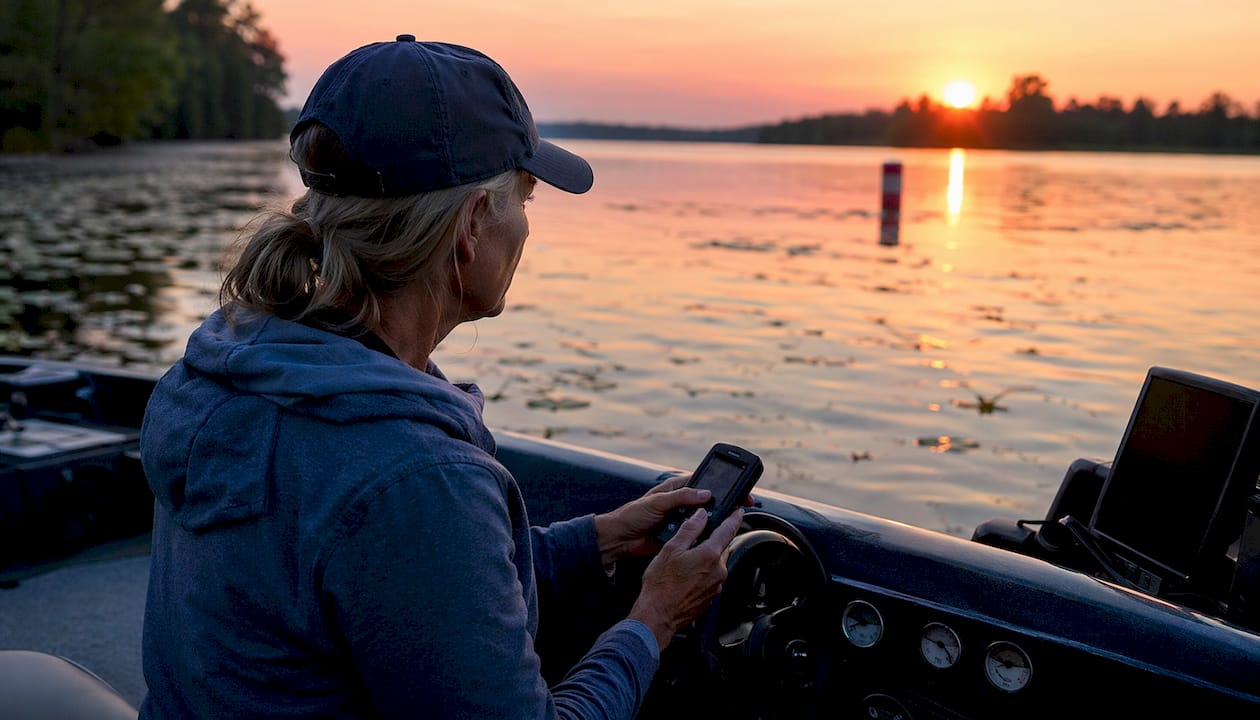
Industry experts confirm that positioning is about controlling the angle of bait presentation with current, not just distance from the target. That distinction matters. A boat anchored 60 feet up-current but at the wrong angle will push bait sideways across the structure instead of through it. Fish face into the current to ambush prey, so your bait must arrive from the direction they are already watching.
The standard starting point for anchored fishing places your boat 30–90 feet up-current of the target structure. For drift fishing, you begin 100–200 yards up-current to cover ground progressively without alerting fish. These distances are not arbitrary. They give your bait time to sink and settle into a natural presentation before reaching the fish.
What are the key boat positioning techniques and principles?
Anchoring and scope ratios
Anchoring is the foundation of stationary boat positioning. Scope ratios determine how much anchor line you deploy relative to water depth: 5:1 in calm conditions, 7:1 as a standard setting, and 10:1 in strong current. Anchor weight follows a simple rule of approximately 1 pound per foot of boat length. Too little scope and the anchor drags. Too much and you swing wide of your target.
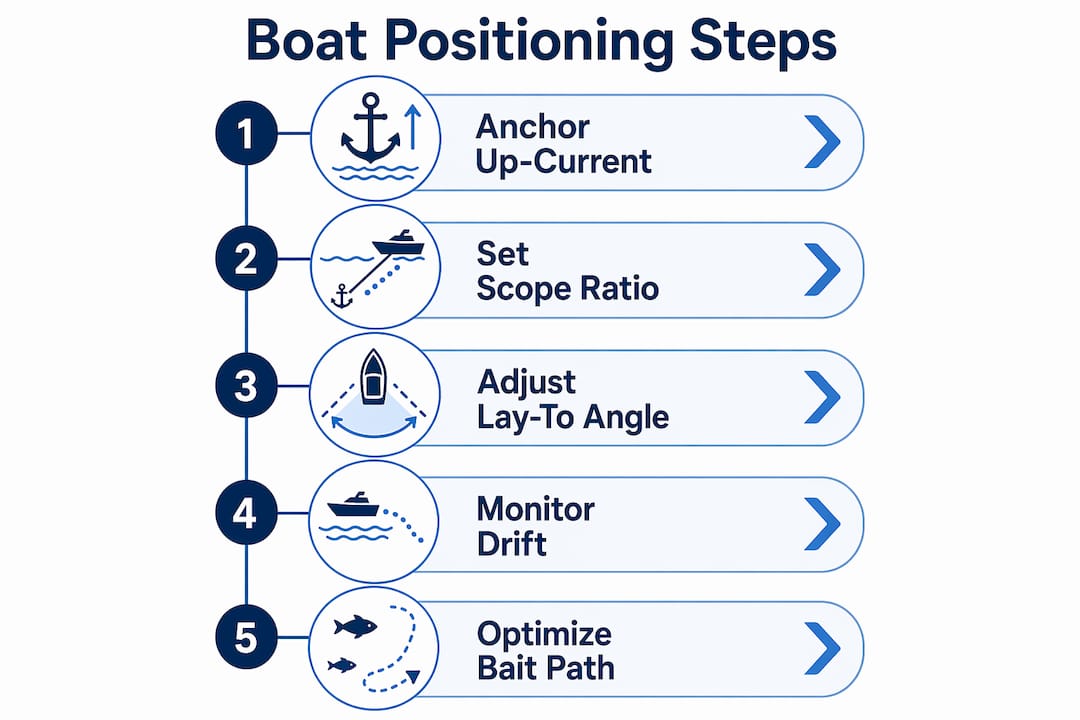
Never drop an anchor directly on a reef or wreck. Dropping on structure damages habitat and fouls your gear. Use GPS marks or visual bearings to position the boat, then back down slowly while paying out rode to test the hold. Once the anchor grabs, the boat should swing naturally into alignment with the current.
The lay-to position and angle of attack
The lay-to position describes how your boat sits relative to wind and current when at rest. Ideally, the bow faces into the dominant force, whether that is current or wind. When wind and current oppose each other, the boat can sit broadside, which complicates bait presentation and line management. Experienced anglers read this conflict and adjust anchor position or use a stern anchor to hold the correct angle.
Angle of attack refers to the direction your bait travels through the strike zone. A bait drifting straight through a channel cut is far more effective than one crossing it at 45 degrees. Small adjustments in boat angle, even just 10–15 degrees, change the entire presentation.
Pro Tip: Before setting anchor, put the engine in neutral and watch how the boat drifts for two to three minutes. That drift shows you exactly where the current will carry your bait and where to drop the hook for a perfect presentation.
| Condition | Scope Ratio | Anchor Distance from Structure |
|---|---|---|
| Calm water | 5:1 | 30–50 feet up-current |
| Standard conditions | 7:1 | 50–90 feet up-current |
| Strong current | 10:1 | 90–150 feet up-current |
| Drift fishing start | N/A | 100–200 yards up-current |
How do current and wind impact boat positioning and bait presentation?
Current is the single most powerful force shaping where fish hold and how they feed. Fish face into the current to ambush prey carried by the flow. Your boat must stay up-current of the fish, and your bait must arrive ahead of the boat’s shadow, noise, and vibration. Ignoring this sequence is the most common mistake anglers make when learning how to position a boat for fishing.
Current strength directly controls your terminal tackle choices. Stronger currents require heavier sinkers and shorter leaders to keep bait near the bottom. In fast water, adjust your positioning distance from 30 feet up to over 150 feet from structure, depending on how quickly the bait sinks and drifts. A sinker with swivels helps maintain bait depth and reduces line twist in strong flows.
Slack tide creates a different problem. At slack water, fish become less active and bait barely moves. Move your boat 20–50 feet up-current of structure, since baits will not drift far. Smaller, lighter presentations work better during this window.
Wind adds a second layer of complexity when it opposes the current. The boat may sit broadside, dragging bait across the strike zone at an unnatural angle. Here is how experienced anglers adapt:
- Use a stern anchor to hold the bow into the current regardless of wind direction.
- Increase sinker weight to cut through wind-driven surface drift.
- Shorten leader length so bait stays close to the bottom and out of the wind-affected surface layer.
- Start drift runs from further up-current to account for the slower, wind-interrupted drift speed.
- Watch the natural drift pattern of your boat in neutral before committing to an anchor position.
Pro Tip: When wind and current run in opposite directions, drop a small marker buoy on the structure. Watch how it moves. That tells you the true net drift direction, which is what your bait will follow.
What modern technologies assist in precise boat positioning for fishing?
GPS-integrated electronic positioning has changed how anglers hold position on the water. Spot-Lock technology on trolling motors allows hands-free position control, holding the boat within a few feet of a GPS coordinate without a physical anchor. As of 2025 and 2026, electronic positioning has become a standard tool for serious recreational anglers. It eliminates anchor noise, reduces motor vibration that spooks fish, and lets you reposition instantly when conditions shift.
Fishfinder integration takes this further. Modern units combine sonar mapping with GPS to show structure, depth contours, and fish location simultaneously. You mark a productive spot on the sonar, lock onto it with Spot-Lock, and fish it without ever touching an anchor. Real-time underwater mapping lets you identify new structure on the fly and reposition within seconds.
The practical benefit goes beyond convenience. A physical anchor disturbs the bottom and can alert fish in shallow, clear water. Electronic positioning keeps the boat quiet and still, which matters most when targeting wary species in shallow water fishing environments.
Pro Tip: Match your trolling motor’s thrust rating to your boat’s length and weight before relying on Spot-Lock in current. An underpowered motor will drift off position in strong flow, defeating the purpose of electronic anchoring.
For anglers who want to understand how boat design affects positioning capability, the sportfishing boat buying guide from Yachting Experts covers hull design and motor placement considerations that directly affect how well a boat holds position.
How do anglers apply boat positioning techniques in different fishing scenarios?
Anchored bottom fishing
Set your anchor 30–90 feet up-current of the target structure. Back down slowly while paying out rode. Once the anchor holds, cut the engine and let the boat swing into position. Never anchor directly on reefs or wrecks. Use GPS marks to confirm you are holding in the right spot. Drop baits and let the current carry them into the strike zone naturally. Pair your rig with a sinker normal shape to maintain bottom contact without excessive drag.
Drift fishing runs
Start 100–200 yards up-current of the structure you want to cover. All anglers fish from the up-current side of the drifting boat to prevent crossed lines. Let the boat drift naturally over the structure, covering ground progressively. Reset the drift by motoring back up-current quietly, well away from the fish zone before circling back.
Trolling
Trolling requires keeping lures far enough behind the boat to avoid spooking fish, while staying manageable during turns. Lines follow the shortest path on turns and will tangle if not spaced correctly across rod holders. Use offset rod positions and stagger lure depths to keep presentations separated. Sportfishing techniques for trolling are covered in detail at Yachting Experts if you want a broader overview of multi-rod setups.
Common mistakes anglers make when positioning boats:
- Anchoring directly over the structure instead of up-current of it.
- Failing to account for tide changes that shift the boat’s angle mid-session.
- Leaving the engine in gear near hooked fish. Even in neutral, propeller rotation from water flow can damage lines.
- Starting drift runs too close to structure, which spooks fish before the bait arrives.
- Ignoring boat draft when positioning in shallow water, risking grounding as the tide drops.
Pro Tip: Spend five minutes observing your boat’s natural drift before every session. Local current and wind dynamics change daily, and what worked last week may put you in the wrong spot today.
Key Takeaways
Effective boat positioning in fishing requires placing your vessel up-current of structure, controlling bait angle, and adapting to current, wind, and tide to deliver natural presentations that trigger strikes.
| Point | Details |
|---|---|
| Position up-current always | Place your boat 30–90 feet up-current for anchoring, 100–200 yards for drift runs. |
| Angle matters as much as distance | Bait must travel through the strike zone, not across it. Adjust boat angle accordingly. |
| Current controls your tackle | Stronger current demands heavier sinkers, shorter leaders, and greater distance from structure. |
| Slack tide requires repositioning | Move 20–50 feet closer to structure at slack water since bait movement slows dramatically. |
| Electronics replace physical anchors | GPS Spot-Lock holds position hands-free, reduces disturbance, and allows instant repositioning. |
What I’ve learned from getting boat positioning wrong
I spent my first two seasons fishing from the wrong side of every reef I targeted. I knew the fish were there. The sonar confirmed it. But I kept anchoring on top of the structure, dropping bait straight down, and wondering why I was getting short strikes and spooked fish. The lesson took longer to learn than it should have.
Reading current is a skill that does not come from a chart. You have to watch the water. Floating debris, tide rips, and the way your anchor line angles off the bow all tell you more than any GPS unit. I started spending five minutes in neutral before every anchor set, just watching where the boat wanted to go. That single habit changed my catch rate more than any gear upgrade I have ever made.
Electronic positioning tools are genuinely useful, but they reward anglers who already understand the fundamentals. If you do not know why you are locking onto a specific GPS coordinate, the technology will not save you. Spot-Lock holds you in the wrong spot just as efficiently as the right one.
Boat draft and tide height are the factors most anglers overlook until they are stuck on a flat with a falling tide. Check the tide tables before you commit to a shallow-water position. A boat that floats fine at high water can be sitting on sand two hours later. Patience and preparation on the front end prevent expensive problems on the back end.
— Alaa
Gear and trips that put these techniques into practice
Justfishinggroup carries the terminal tackle and gear that make proper boat positioning work in real conditions.
The right sinker keeps your bait at the correct depth when current pushes hard. The right rod gives you the sensitivity to feel what the bait is doing 80 feet down-current. Justfishinggroup’s fishing gear shop stocks sinkers, hooks, lures, and rods suited for anchored, drift, and bottom fishing setups. If you want to practice these techniques with expert guidance on the water, the guided fishing trips across the Maldives, UAE, Seychelles, and beyond put you in the hands of captains who live these positioning principles every day. Gear and experience together are what turn theory into fish in the boat.
FAQ
What is boat positioning in fishing?
Boat positioning in fishing is the deliberate placement and orientation of your vessel to deliver bait naturally into the strike zone. The boat stays up-current of structure so bait reaches fish before the boat does.
How far up-current should I anchor from structure?
Position your boat 30–90 feet up-current for anchored fishing and start drift runs 100–200 yards up-current. Exact distance depends on current speed and how quickly your bait sinks.
What scope ratio should I use when anchoring?
Use a 5:1 scope ratio in calm water, 7:1 as a standard setting, and 10:1 in strong current. Anchor weight should be approximately 1 pound per foot of boat length.
How does slack tide affect boat positioning?
Slack tide reduces current and makes fish less active. Move your boat 20–50 feet closer to structure at slack, since bait will not drift far enough to cover ground from a standard anchoring distance.
Can electronic positioning replace a physical anchor?
GPS Spot-Lock technology holds your boat within a few feet of a target coordinate without a physical anchor. It reduces bottom disturbance, eliminates anchor noise, and allows instant repositioning when fish move or conditions change.