Address: M5, Al Naumi Tower , Al Mina Road, Al Zahya Area, Abu Dhabi City, UAE
Email: support@justfishinggroup.com
Store Hours: 10:00 - 18:00, Mon - Sat
Legal
© 2025 JustFishing. All Rights Reserved.



Address: M5, Al Naumi Tower , Al Mina Road, Al Zahya Area, Abu Dhabi City, UAE
Email: support@justfishinggroup.com
Legal
© 2025 JustFishing. All Rights Reserved.
Barbed vs Barbless Fish Hooks
February 12, 2026, 918
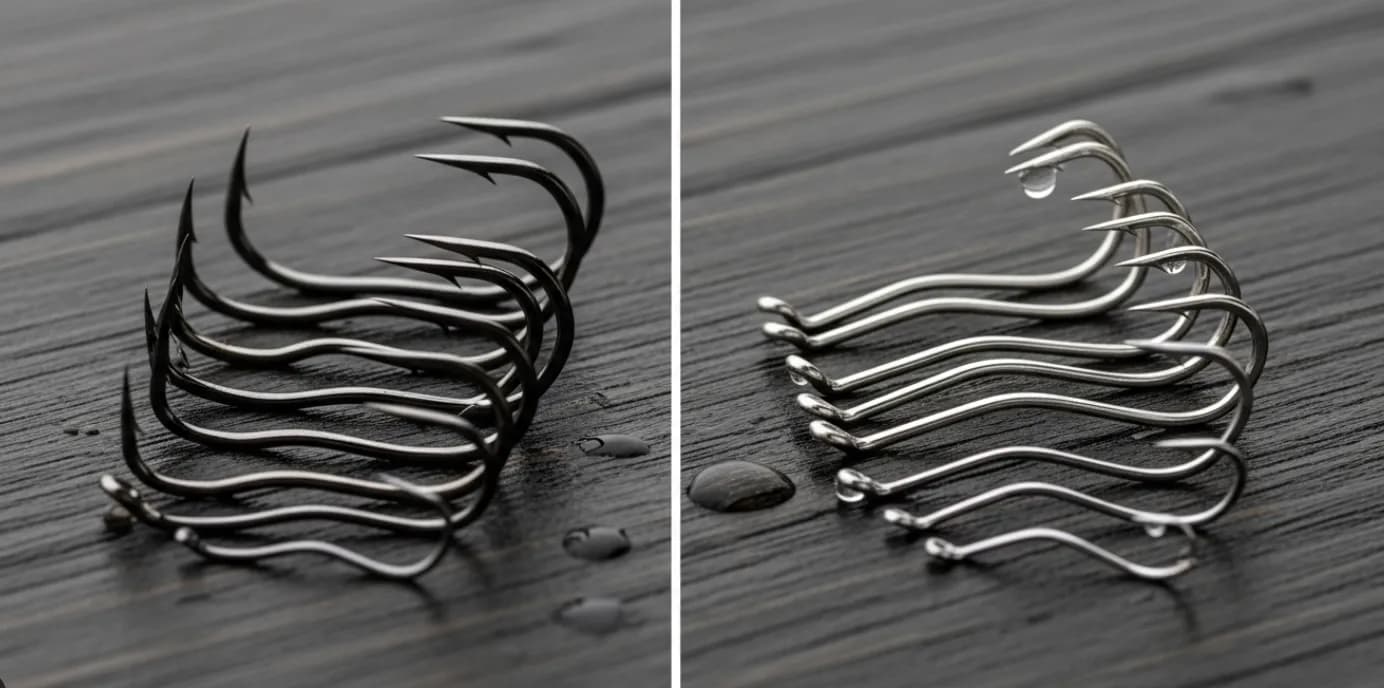
It is important that the kind of hook that you use matters when it comes to successful fishing. The argument of barbed vs barbless fish hooks is a common issue among fishermen, with barbs having both advantages and disadvantages.
The former is easier to catch a fish as it has smaller projections (barbs) that attach to the tip. The barbless (non-barbed) hooks do not have such projections and therefore enter effortlessly and strip quickly, causing less damage to the fish. This article compares the two of them.
The following is a complete comparison between barbed vs barbless fish hooks to decide for your next adventure.
The Hayabusa Jack Eye Shot Slot Hook is one such example of a good barbed hook.
In most fisheries, the use of barbed vs barbless fish hooks for bass is limited to preserve fish. In catch-and-release waters, conservation-conscious laws may sometimes demand the use of barbless hooks. An example is that some freshwater must be catch-and-release and must have barbless hooks.
Similarly, NOAA advises the use of barbless hooks on endangered species such as salmon and steelhead to facilitate survival. An example of enforcement agencies, the DFO of Canada has discovered recently those violating the acts by utilizing barbed hooks.
Barbed hooks are prohibited in certain venues since they might result in more profound wounds and in escape obstacles, whereas barb-free types can prevent fines and help fish welfare.
One such example is to adhere to such regulations by using barbless assist hooks such as the SnapBait Triple Threat Assist Hook, which has no standard barb.
Not really; when the barbed vs barbless fish hooks are compared, the barbless hooks in fact reduce damage when used. Research indicates barbless hooks result in smaller and less harmful wounds and blood loss compared to barbed hooks. It is much easier to remove a barbless hook, so the fish spends less time out of water.
The meta-analysis of studies on catch and release showed a significant differentiation in mortality rates between barbless hooks (8.2%) and barbed hooks (14.6%). Practically, a barbless hook is easier and softer to extract, leaving a freed fish with a far greater possibility to survive.
To achieve a more friendly fishing experience, use such a barbless hook as the CB One Liftex Blitz Assist Hook.
The argument of the catch rate concerning barbed vs barbless fish hooks for bass is subtle. Anglers in a study took 22% more fish on barbed hooks than barbless. In real fishing, the success of hooking is sometimes related more to the technique and hook sharpness than to the availability of a barb.
There is also an argument among some anglers that a barbless hook does go in faster (similar to a spear); however, when tension is well taken care of in both styles, then fish can be brought to the surface. In order to increase your hookup rate with barbless hooks, continue rod tension and hookset.
Looking to get a barbless but bright hooking hook? Check out the barbless but aggressive CB One Sinking Pencil Front Hook.
Barbed hooks have been found to pull ahead in the debate between barbed vs barbless fish hooks due to the fact that they remain attached after the hook has entered the fish mouth. The reason why you should use them in a legal circumstance is as follows:
The Jig Player Feather Assist Hook is a heavy-duty barbed hook that has been constructed to securely stand in hard environments.
It is normal to lose fish on barbless hooks when there is a lapse in technique. In the discussion of barbed vs barbless fish hooks for bass, the barb is not present, and this allows the hook to free itself more easily.
The solution comes in maintaining a total tension all the time; even by the slightest relaxation of the line, a hook with no barb will spring up. Ensure that your rod is bent (C-shaped) and lift in the opposite direction of the pull of the fish to ensure your hook sticks. Losing fish decreases with experience.
The Jig Player Pike Assist Hook will be a good hook; it is very sharp and will hold fish firmly even when unbarbed.
The term "non-barbed" is virtually an equivalent of "barbless." So no, it is not hurting the fish, and this is the same reason behind the use of non-barbed circle hooks in fisheries, and this is to facilitate removal and reduce mortality among the fish.
Rust rate is independent of the bars themselves. The rusting in the debate on barbed vs barbless fish hooks has nothing to do with whether a hook has a barb or not. Indeed, most fishermen deliberately use non-stainless steel hooks (steel or bronze): they will corrode and will drop out of a fish.
Practically, the barb or no barb of a hook is irrelevant to corrosion, but what is important is the material of the hook and good handling. To get a high-end non-barbed version, the BKK Shore Patrol Assist Hook would do the trick.
Barbless hooks are best suited to the novice, as they cause less harm to the fish and release them more quickly, which aids a new angler in becoming familiar with the technique.
Although they need a constant tension on the line, they develop more skills in the control and setting of hooks by use of barbless hooks, and fishing is made safer, easier, and friendlier to the fish.
Both barbed vs barbless fish hooks find their own place. Barbed hooks provide the angler with a good hookup, and they are invaluable when retention is paramount, but barbless hooks are much gentler on fish and are becoming more and more necessary in catch-and-release fisheries.
Our catalog contains a host of hooks of all styles to match any type of fishing, so check it out.
Rate this blog
Categories
Popular Tags


